

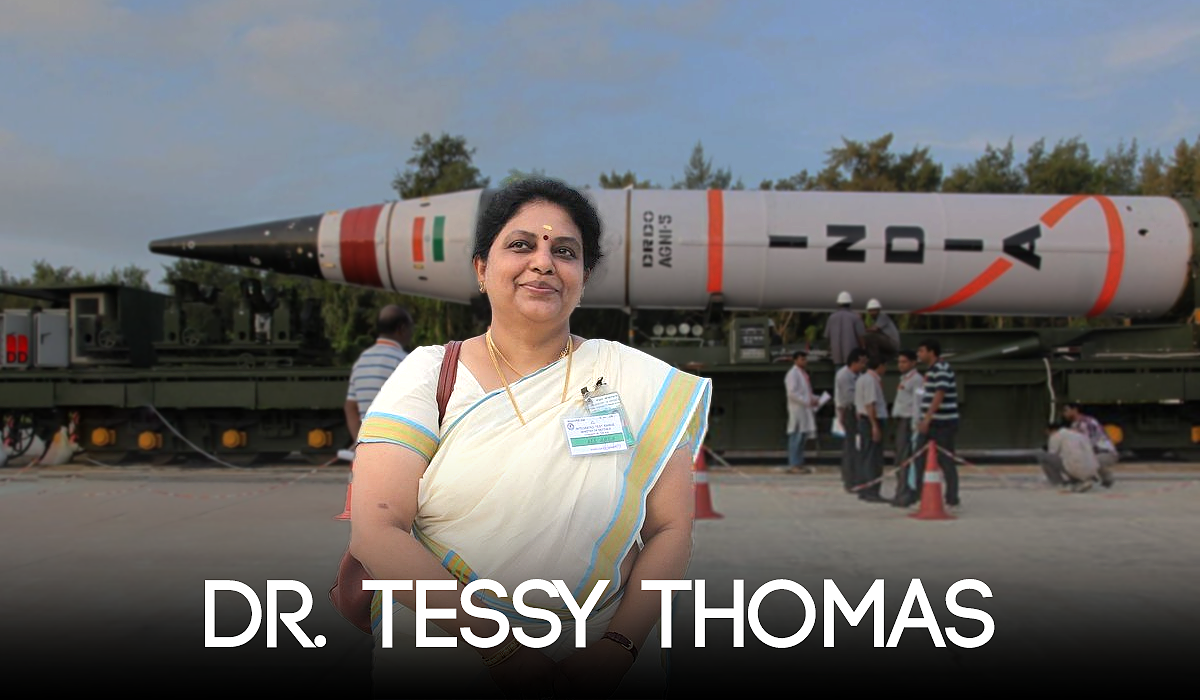
The journey of Tessy Thomas, widely known as the “Missile Woman of India,” marks a significant chapter in the country’s push toward self-reliance in defence technology. Her distinguished career at the Defence Research and Development Organisation (DRDO), which began in 1988, has been defined by her leadership in critical missile programs, particularly the Agni-4 and Agni-5 projects. These missions played a crucial role in strengthening India’s strategic defence capabilities at a time when access to advanced foreign technology was highly restricted. Today, she continues to contribute to academia as a Vice Chancellor, guiding and mentoring future scientists and innovators.
Born in Kerala, Dr. Thomas developed an early curiosity about science, inspired by her fascination with the moon and nurtured by supportive parents and teachers. Although she did not initially set out to work in missile technology, her strong inclination toward mathematics and science led her to pursue engineering. After completing her studies, she secured admission to a DRDO-sponsored M.Tech program in missile technology through a competitive selection process, laying the foundation for her future contributions to India’s defence sector.
In her early years at DRDO, Dr. Thomas worked in a predominantly male environment but remained focused on building her expertise and making meaningful contributions. She played a vital role in developing key systems such as guidance and control mechanisms, inertial navigation, trajectory simulations, and mission design for long-range ballistic missiles. Operating under a strict technology denial regime, her team relied heavily on indigenous innovation and fundamental scientific principles to achieve their goals. She has often emphasized that success in such high-stakes projects requires not just technical knowledge, but a deep understanding of underlying principles, combined with teamwork and shared responsibility.
A major influence on her professional journey was A. P. J. Abdul Kalam, whose mentorship shaped her leadership approach. He encouraged independent thinking and viewed failure as an essential part of the learning process. Dr. Thomas frequently recalls his metaphor comparing birds seeking shelter from rain to the eagle that rises above the clouds, a philosophy that reinforced her resilience and determination in tackling complex national missions.
In recent years, Dr. Thomas has highlighted the growing participation of women in STEM fields, attributing this progress to supportive government initiatives and the implementation of the National Education Policy 2020. She believes that the policy has made science education more practical and relevant for students. Her contributions were formally recognized in 2025 when she received the Dr Paulos Mar Gregorios Award for excellence in science and women’s empowerment. She continues to advocate for stronger support systems at home and in workplaces to encourage more women to pursue careers in demanding scientific fields.
Despite the pressures of her professional responsibilities, Dr. Thomas successfully balanced her career with family life, crediting her parents, husband, and son for their constant support. She maintains that effective time management, clear prioritisation, and confidence rooted in knowledge are essential for handling such responsibilities. Looking ahead, she has identified emerging fields such as artificial intelligence, quantum computing, and autonomous systems as key areas for future growth in Indian science. Her message to young aspirants remains clear: stay curious, remain dedicated, and embrace continuous learning, as every challenge presents an opportunity for growth.






Comments (0)
No comments yet. Be the first to comment!
Leave a Comment