

West Bengal Election Results 2026 - Detailed Overview
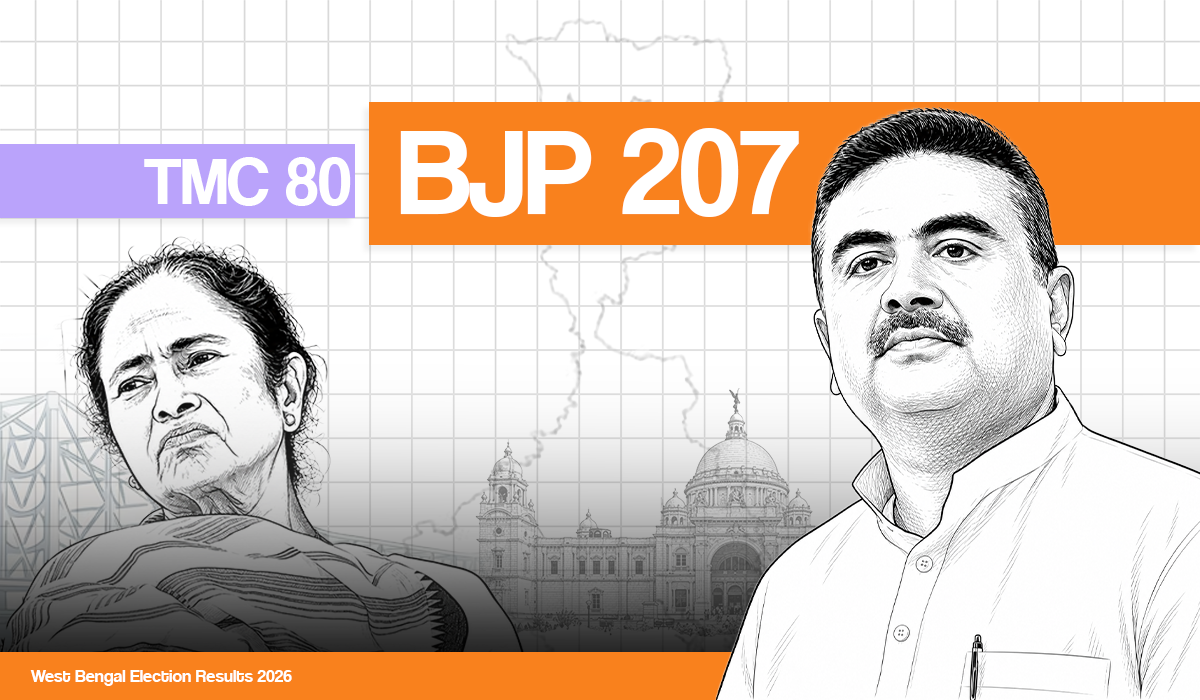
The West Bengal Assembly Election Results 2026 have delivered a decisive verdict, with the Bharatiya Janata Party emerging as the clear winner by securing 207 out of 294 seats. This landslide victory gives BJP a strong and stable majority in the state assembly.
In contrast, the All India Trinamool Congress has been limited to 80 seats, reflecting a notable decline in its electoral dominance. The outcome signals a significant shift in voter preference across the state.
The Indian National Congress managed to secure just 2 seats, while smaller parties had minimal presence. The Aam Janata Unnayan Party also won 2 seats, and both the Communist Party of India (Marxist) and All India Secular Front secured 1 seat each, highlighting the reduced influence of traditional opposition groups.
Party-wise Results Breakdown
| Party | Seats Won |
|---|---|
| Bharatiya Janata Party (BJP) | 207 |
| All India Trinamool Congress (AITC) | 80 |
| Indian National Congress (INC) | 2 |
| Aam Janata Unnayan Party (AJUP) | 2 |
| Communist Party of India (Marxist) – CPI(M) | 1 |
| All India Secular Front (AISF) | 1 |
The 2026 election marks a major political transition in West Bengal. The scale of BJP’s victory indicates strong support across urban, semi-urban, and rural regions. The party’s ability to expand its voter base across diverse demographics played a crucial role in achieving this outcome.
At the same time, the reduced seat count of TMC suggests erosion in several key constituencies where it previously maintained dominance. The results point toward a broader realignment of voter sentiment, with many regions opting for change.
The limited success of Congress and Left-aligned parties further reinforces the growing bipolar nature of West Bengal politics, now largely centered around BJP and TMC.
The West Bengal Assembly Election 2026 has reshaped the state’s political landscape, positioning BJP as the dominant force with a commanding majority. With 207 seats, the party is set to lead the government, while TMC, with 80 seats, assumes the role of the principal opposition.
These results are expected to influence governance priorities and political strategies in the coming years, marking a new phase in West Bengal’s electoral history.





Comments (0)
No comments yet. Be the first to comment!
Leave a Comment