

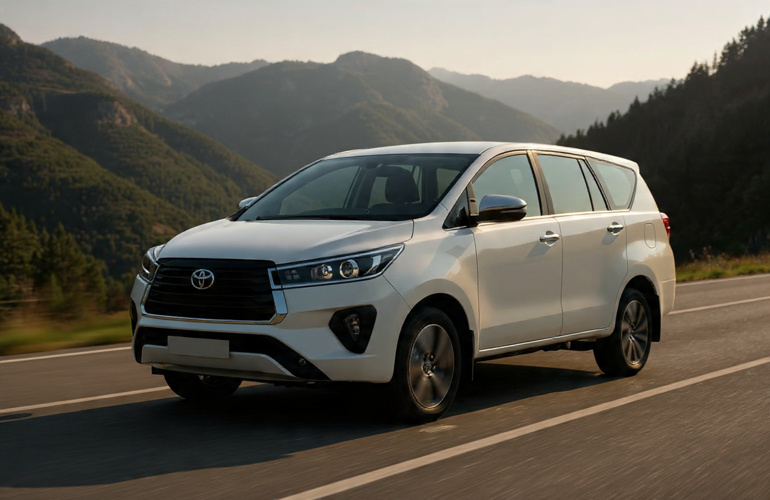
The possible exit of the Toyota Innova Crysta from the Indian market by early 2027 is not just another automobile update; it is a moment that signals the end of a deeply rooted automotive legacy. For years, the Innova Crysta has been more than just a vehicle in India—it has been a symbol of dependability, long-distance comfort, and strong resale value. From middle-class families to business owners and even high-profile personalities like Rajanikant, the Crysta managed to earn trust across diverse user groups without relying on flashy marketing or over-the-top features.

What made the Innova Crysta unique was its consistency. While many vehicles in the Indian market evolved rapidly in design and features, often compromising durability, the Crysta maintained a balanced approach. It focused on providing a solid driving experience, spacious interiors, and low maintenance costs. Fleet operators especially viewed it as a long-term asset rather than a depreciating purchase, which further strengthened its dominance in the MPV segment. This level of trust is rarely seen in today’s fast-changing automotive industry.

However, the decision by Toyota to phase out the model appears to be driven by larger industry shifts rather than declining popularity. One of the most significant reasons is the tightening of emission regulations in India. Diesel engines, which have been the backbone of the Innova Crysta, are becoming increasingly difficult to sustain under future norms. Upgrading these engines to comply with upcoming standards would significantly raise production costs, making the vehicle less viable in a price-sensitive market like India.
At the same time, the Indian automobile market is undergoing a transformation in terms of buyer preferences. Today’s customers are no longer satisfied with just reliability; they expect advanced features, better fuel efficiency, and environmentally friendly options. This shift has pushed manufacturers to invest heavily in hybrid and electric technologies. Toyota has already taken a step in this direction with newer models, indicating that the company is preparing for a future where traditional diesel-powered MPVs may no longer dominate.
Another important factor is the gradual repositioning of Toyota’s product lineup in India. Instead of focusing on purely functional vehicles, the brand is moving toward premium, tech-enabled mobility solutions. This means introducing models that combine comfort with modern features such as connected technology, improved safety systems, and hybrid powertrains. In this context, continuing with an older platform like the Innova Crysta may not align with the company’s long-term strategy.
For consumers, the discontinuation of the Innova Crysta will have mixed implications. On one hand, it marks the end of a vehicle that has been a trusted companion for millions of Indian families. On the other hand, it opens the door to more advanced and environmentally responsible options. Interestingly, the resale value of the Innova Crysta is expected to remain strong even after discontinuation, as demand for reliable used vehicles continues to grow in India. This could make existing owners benefit financially despite the model being phased out.
What many people may not realize is that the Innova Crysta’s success has also influenced how car manufacturers approach the Indian market. It proved that Indian buyers value long-term reliability over short-term appeal, and that a well-built vehicle can sustain its popularity for over a decade without major reinvention. Even as newer models take over, this philosophy is likely to continue shaping future vehicle designs.
The expected discontinuation by early 2027 is therefore not just about ending production; it represents a shift in priorities—from durability-focused diesel vehicles to technology-driven, eco-friendly mobility solutions. As India moves toward a greener and more connected automotive future, the legacy of the Innova Crysta will remain as a benchmark of trust and practicality that defined an entire era of Indian roads.



Comments (0)
No comments yet. Be the first to comment!
Leave a Comment