

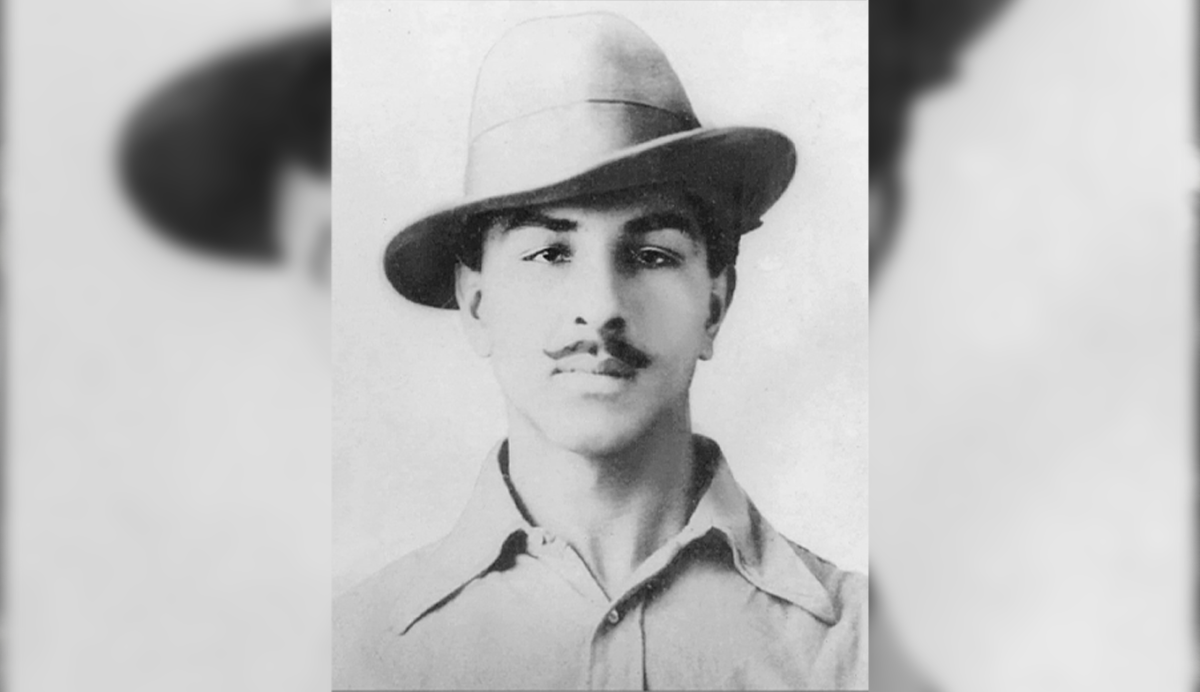
Every year, as the nation observes Shaheed Diwas on March 23, the name of Bhagat Singh rises above time, echoing through generations as a symbol of fearless patriotism and unyielding resistance. He was not merely a revolutionary; he was an idea, an idea of courage, sacrifice, and a relentless pursuit of freedom that refused to bow before oppression.
Born on September 28, 1907, in Banga village of Punjab, Bhagat Singh was destined to walk a path different from most. Raised in a family deeply involved in India’s freedom struggle, patriotism was not taught to him, it flowed in his blood. From a young age, he witnessed the brutality of British colonial rule, but it was the Jallianwala Bagh massacre of 1919 that left an indelible mark on his conscience. The soil soaked with innocent blood ignited in him a fire that would never be extinguished.

Bhagat Singh believed that freedom was not a gift to be begged for but a right to be seized. As he grew older, his ideology matured. He was not driven by blind rage but by a well thought out vision of an independent India, free not only from British rule but also from exploitation and injustice within society. He read extensively, studied global revolutions, and shaped his understanding of nationalism with depth and intellect. For him, patriotism meant not only loving the country but also striving to transform it.

The turning point in his revolutionary journey came with the death of Lala Lajpat Rai in 1928. The veteran leader had been severely injured during a protest against the Simon Commission and later succumbed to his injuries. Bhagat Singh, along with his comrades, decided that this injustice could not go unanswered. In an act of defiance, they assassinated British officer J.P. Saunders, believing him responsible for Rai’s death. This was not an act of mere revenge, it was a statement against tyranny.
However, what truly set Bhagat Singh apart was not just his courage but his philosophy. In 1929, along with Batukeshwar Dutt, he threw non lethal bombs in the Central Legislative Assembly in Delhi. The bombs were deliberately designed not to kill but to make a noise, to make the deaf hear. Instead of fleeing, both revolutionaries courted arrest. Bhagat Singh used the courtroom as a platform to spread his message, turning his trial into a powerful political statement.
During his imprisonment, he undertook a historic hunger strike, demanding equal treatment for Indian prisoners. His protest was not for personal comfort but for dignity and justice. The strike drew nationwide attention, and Bhagat Singh became a household name. He was no longer just a revolutionary, he had become the voice of a restless nation.
At the age of just 23, Bhagat Singh, along with Rajguru and Sukhdev, was sentenced to death. On March 23, 1931, they walked to the gallows with unmatched courage. It is said that Bhagat Singh was reading a book until moments before his execution. As he embraced martyrdom, he did not show fear, only a calm acceptance of his destiny for the greater good of the nation.
His last words and actions were not of despair but of hope. He believed that his sacrifice would awaken millions, and history has proven him right. Bhagat Singh did not live long, but he lived with a purpose that continues to inspire even today.
From a nationalist perspective, Bhagat Singh represents the soul of India’s freedom struggle, bold, uncompromising, and deeply rooted in justice. He was not confined to one ideology or method; instead, he embodied the spirit of resistance in its purest form. His life reminds us that freedom is not merely political independence but a continuous responsibility.
As we remember him on Shaheed Diwas, it is essential to move beyond mere remembrance. Bhagat Singh’s vision calls for action, action against injustice, inequality, and indifference. His sacrifice was not meant to be mourned but to be honored through our deeds.
In the pages of history, many names are written, but only a few become eternal. Bhagat Singh is one such name, a martyr whose legacy refuses to fade, a revolutionary whose voice still echoes, and a patriot whose dream still lives within every Indian heart.





Comments (0)
No comments yet. Be the first to comment!
Leave a Comment